
And I did not walk it.
My grandfather carried me.
He picked me up so I could see over the edge of the casket.
My mother was in it.
I didn’t understand that then. I remember a woman lying still. And I remember the arms that lifted me. Who she was, and what I had just lost, came to me in pieces over years. The way it does when you’re too young to be told straight.
That was 1972.
A couple of years later I was back in that same room, looking at that same spot. And my grandfather was the one lying in it.
Friendship Baptist Church. East 55th and Central.
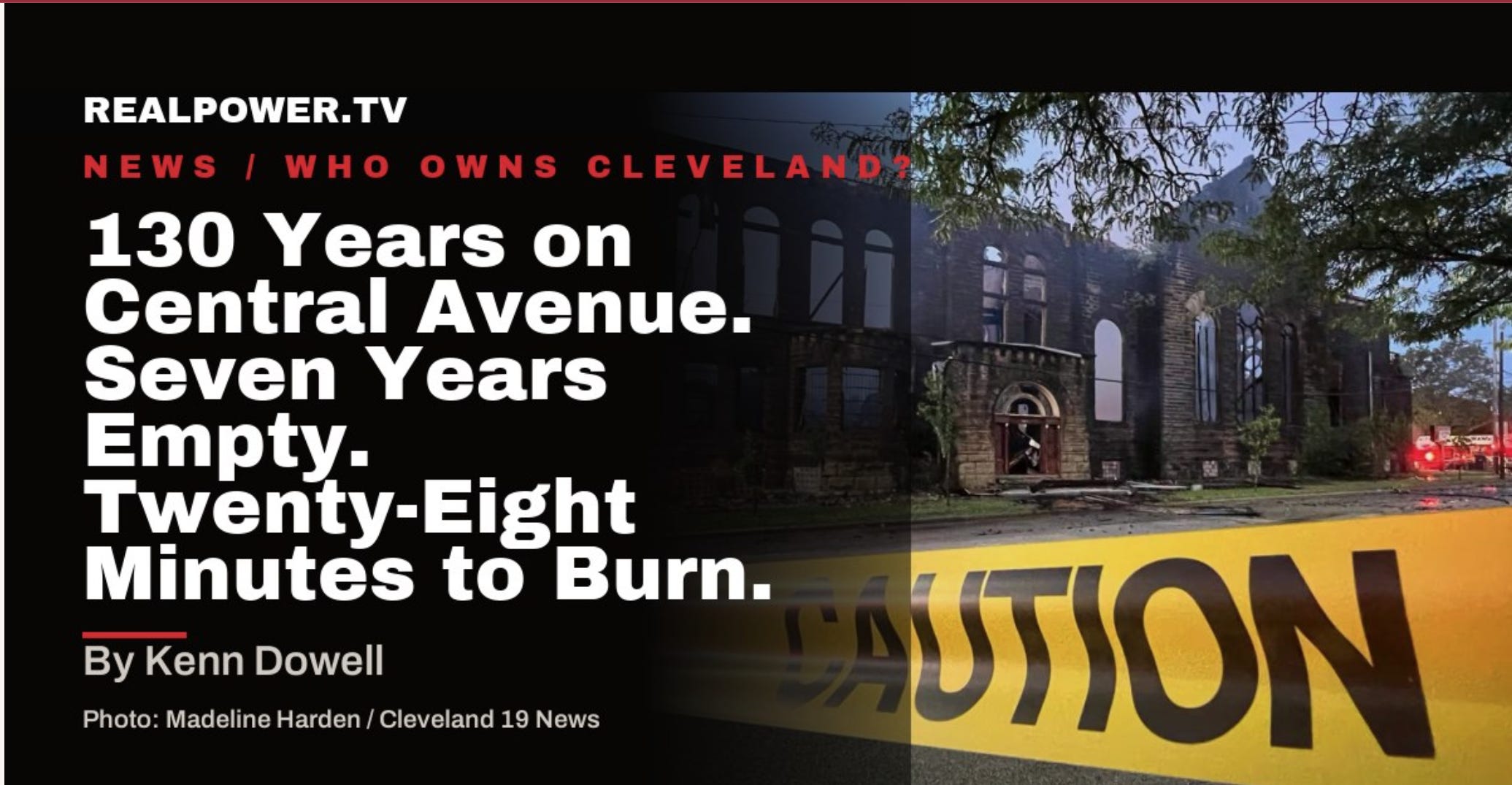
It burned to the ground on August 21st.
My grandfather was the Reverend David Wilkins, pastor of Shepherd Institutional Baptist Church. The man in the pulpit at Friendship was the Reverend James Stallworth. And Stallworth was not a small man in this city.
Over a thousand members filled that sanctuary in the fifties and the sixties, and his name carried in the National Baptist Convention U.S.A., Incorporated, which in that era meant it carried nationally.
Two pulpits. Blocks apart. Working the same corridor.
That’s what people mean when they say the church was the institution. Not that folks were religious. That in Central, in that generation, the pulpit was the only structure that answered to Black people directly.
It didn’t need a grant. It didn’t need a councilman’s blessing.
It buried you, married you, fed you, and organized you, on money that came out of Black pockets on Sunday morning. realpower.tv
My grandfather stood in one of those buildings. Stallworth stood in the other. And both times my family had to bury somebody, it happened under Stallworth’s roof.
I can’t tell you from my own memory who preached over either casket. I was four for one, and barely older for the other.
What I can tell you is that my family’s ties to that pulpit ran through two generations of Stallworths. James, and then Leon after him. And ties like that don’t get built in a season. They get built over decades, by people who show up for each other’s dead.
Most people didn’t know what that building was until the week it stopped existing.
It went up in 1896 as a synagogue. Those families worshipped there, and then they moved east, the way Cleveland always moves. In 1924 they sold it to Mount Zion Congregational, the church of Black Cleveland’s professional class. Mount Zion moved too. And in 1940 it became Friendship Baptist, and it belonged to working Black Central.
Three congregations. Three migrations. One address.
Every group that ever needed that building took what it needed and left when something better opened up.
Friendship was the last one in the door.
And when the numbers came down, and they came down hard, from over a thousand at the peak to about forty by 2014, there was nobody behind them. No congregation waiting to buy it. No developer circling.
So it sat.
For roughly seven years, a landmark that had buried half of Central stood empty on one of the busiest corners on the East Side. And the answer to who was responsible for it was nobody in particular.
Here’s what got reported.
According to the arrest warrant, on the night of August 20th, a nineteen-year-old named John Patrick McManamon drove to 5600 Central Avenue. He parked behind the church with two other people, and they went inside to take part in a social media trend called urban mining.
A photo taken inside and posted to social media shows, in the language of that warrant, the early stage of a fire with multiple points of origin.
They left twenty-eight minutes later.
The first call came in more than an hour after that.
Firefighters filled that corner. The roof came down. Cleveland Fire ruled it arson and said the motive was not financial.
McManamon was arraigned on a felony arson charge, and his case has been bound over to a grand jury. He has not been convicted of anything, and I’m going to say that plainly, because he’s entitled to it same as anybody.
Bond was set at ten thousand dollars.
That’s what a hundred and thirty years of Central Avenue was worth on the docket that morning.
Now, nobody has alleged a hate crime. No official has said race had anything to do with it. If the warrant is right, three teenagers walked into an abandoned building to make content.
And a hundred and thirty years came down.
That is the point.
Nobody burned down a Black church.
Cleveland left the door open for seven years and waited to see who would walk through it.
So who held title to that building? Who was responsible for securing it. What did this city do, in seven years, about a landmark sitting open at East 55th and Central?
And how many more are sitting exactly like that tonight, waiting on their own three teenagers with a phone.
This is not a Cleveland story. Every Black neighborhood in this country has this corner. Detroit has it. Baltimore has it. St. Louis has it.
The building where everybody’s grandmother was eulogized, standing empty. Because the people who loved it never had the capital to hold it, and the people with the capital never had a reason to want it.
We don’t lose these places to fire.
We lose them in the seven years before the fire.
The fire is just the paperwork.
I never got to go back as a grown man. Stand at the front of that sanctuary. Look at the spot where they laid my mother, and then my grandfather, and understand it with a man’s eyes instead of a four-year-old’s.
The pieces came together for me over a long time.
The building was supposed to still be there when they did.
How many more are sitting open tonight? We’re counting. Subscribe and follow this one with us. → realpower.tv
Reminder September 19th 10am-12Noon