


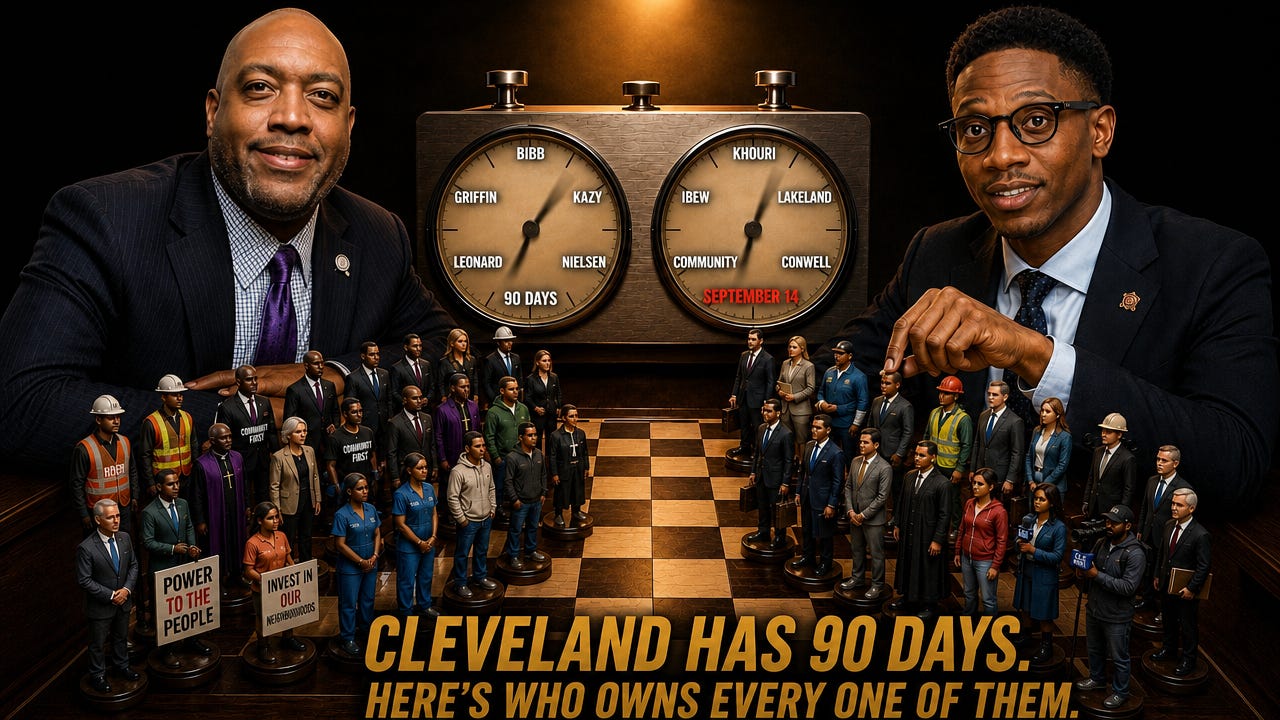
Cleveland Has 90 Days. Here’s Who Owns Every One of Them.
The mayor has a position. The council has a deadline. The developer has an invitation. Nobody gets to stay neutral.
Part 1 laid out the argument nobody made at City Hall. Part 2 names names. Both sides of government. The private sector. Everyone with a seat at this table gets a direct question and a deadline. The 90-day clock is running.
This is Kenn Dowell. Cleveland born. Glenville raised. And never afraid to say what needs to be said.
Before we get into the names, catch up if you need to. Last week I published the paper trail showing City Hall knew about this project a year before the moratorium vote — while telling the public they were surprised. That post is kendowell.substack.com “They Said They Didn’t Know. The Paper Trail Says Otherwise”]. This one picks up where it left off.
Now. Before I get into what I have for you today, I need to correct something from Part 1.
A Correction. And Why It Matters.
In Part 1 I said Cleveland fumbled the IX Center deal. That framing was incomplete.
Amazon Web Services looked at the site and passed. A separate Fortune 100 company — believed to be an EV battery manufacturer — pursued it after that. That deal fell through earlier this year. Sources told NEOtrans the reasons were tied to the slowdown in U.S. electric vehicle demand. Not anything Cleveland did or failed to do.
Different story. And it matters.
I hold this Substack to a higher standard. When I get something wrong I say so. Then we move.
The County Already Moved. Cleveland Is Still Standing Still.
On June 10th, Cuyahoga County Executive Chris Ronayne released a Data Center Development Guide — built to help local communities evaluate proposals and protect residents before signing anything.
He said it plain.
“We owe it to our residents to stop bad deals before they start. Left unchecked, data center projects can drain our power, our water, and our tax dollars without creating enough new jobs or tax revenue.”
Jenita McGowan — the county’s deputy chief of staff for sustainability — backed him up.
“Communities must make decisions that carry significant long-term implications. This guide helps local governments understand energy use, infrastructure demands, environmental impacts, and economic benefits.”
That document is published. Free. Available right now. Cleveland’s working group should have it on the table at their first meeting. If it is not there — somebody needs to put it there today.
The Warning Nobody Said Out Loud.
Cuyahoga County recommends that local officials decline to sign nondisclosure agreements with data center developers.
Pay attention here. A developer approaches a council member. They request a private conversation. They ask for an NDA before revealing the project. Once signed — that official cannot tell their constituents what is being planned in their own neighborhood. Not until the developer is ready to announce it.
That is not a courtesy. That is a strategy.
A Republican state legislator introduced House Bill 695 this year to ban local officials from signing NDAs with data center developers. His argument — communities deserve honesty on major economic decisions. A Republican introducing that bill. A Democratic county official saying the same thing. When those two line up from opposite ends of the political spectrum — pay attention.
Any working group member approached by a developer in the next 90 days needs to know this before they sit down.
Where Does Mayor Bibb Stand — And What Does He Owe This City?
On May 27th at the City Club, Bibb said hyperscale data centers have “no future” in dense city neighborhoods. Residents’ concerns are valid. A 150-megawatt facility cannot show up without community engagement and expect a yes.
But he did not say no to everything.
“The city of Cleveland has data cloud facilities. The county has data cloud facilities. We’re not saying no to that.”
His administration denied Lakeland Equity’s permit on a technicality. No site plans submitted. Procedural rejection. Not a policy one. The door is still open.
Bibb backed the moratorium publicly. But his administration pushed for three months instead of a year. So which is it? You cannot say hyperscale has no future in dense neighborhoods and then push for a timeline so short your working group is still reading the county’s playbook when September 14 arrives.
The mayor owns the administrative side. He owns what the working group produces. He owns the draft zoning language. And he owns what happens if they deliver nothing.Leadership is not an Instagram post. It is a zoning ordinance with your name on it before September 14.
The Administration Owns More Than It Admitted.
And there is one more thing the administration owns now. Because last week the story changed.
Cleveland.com’s Sean McDonnell reported that Cleveland Public Power Commissioner Ammon Danielson signed a letter of support for Lakeland Equity Group. That letter is dated June 25, 2025.
Read that date again. One full year before council voted on this moratorium.
Now hold that next to what the Bibb administration told the public. They said City Hall was caught off guard by this proposal. They said they didn’t know.
The paper trail says otherwise. I broke it down in full last week.
Here is why it matters for the next 70 days. You cannot claim surprise and claim leadership at the same time.
If the administration knew about Lakeland a year out, then the administration had a year to prepare zoning language, a community benefits framework, and a public education plan. It produced none of that. That is not a knowledge problem. That is a choice.
The mayor owns the administrative side of this moratorium. He owns what the working group produces. He owns the draft zoning language. He owns what Kate Nielsen and Shannon Leonard deliver to that table.
And now he owns one more thing — a straight public accounting of who inside City Hall knew about Lakeland, when they knew it, and why the public heard “we were surprised” when a city commissioner’s signature was already on paper.
Leadership is not an Instagram post. It is a zoning ordinance with your name on it before September 14.
Mayor Bibb — Cleveland is watching what your administration produces. Not what you say about it. The clock you are on did not start when the cameras showed up. It started June 25, 2025. You just didn’t tell us it was running.
Cleveland Already Has the Tool. Blaine Griffin Built It.
Most people in that hearing room did not know this either. Cleveland already has a Community Benefits Agreement ordinance. It passed in June 2023. It is already law.
A CBA is not a promise. Not a handshake. It is a legally binding contract. It spells out what a developer delivers before they break ground. Hiring targets. Apprenticeship programs. Environmental monitoring. Direct contributions back into the neighborhood.
Let me give credit where it is due. Blaine Griffin built this tool. He championed it. The 2023 ordinance requires a CBA whenever a developer receives a city incentive of $250,000 or more.
The tool is on the shelf. The only question is whether Cleveland picks it up.
West Des Moines used this same framework with Microsoft. Six facilities. Over $6 billion invested. No tax abatements. One hundred percent renewable energy. $2 billion added to the city’s property tax base over time. Schools improved. Roads rebuilt.
That happened because the city kept its leverage every time it sat down at the table.
The Lakeland Equity proposal is $1.6 billion. Eighty times Cleveland’s $20 million CBA threshold. Cleveland’s own law already requires an expanded community benefit agreement at that scale. Nobody said that clearly at the June 25 hearing. So I am saying it here.
Griffin built the tool for exactly this moment. Now he has to use it.
This Is Personal.
I am not writing about data centers as an abstract policy question.
Early in my career I digitized records for Cuyahoga County government. I watched paper become data with my own hands. I know what this infrastructure is because I helped build an early version of it.
And today I run a media network that lives on that infrastructure. This Substack. The podcast. The radio stream. Every piece of Strategic Moves runs through a data center somewhere. So do the businesses of every creator, every online seller, and every remote worker in this city.
When I speak up for data centers with the right guardrails — I am speaking up for them.
What This Moment Requires of Blaine Griffin.
The people do not know what a data center is. Not because they are not smart. Because nobody has told them in a language they can receive.
A few committee meetings that most working people cannot attend on a Tuesday morning is not a public education campaign. It is a checkbox. Cleveland needs a real campaign. Organized. Coordinated. Taken into every ward. The city leads it. But everybody shows up to deliver it.
Lakeland Equity wants to build in this community. Then come be part of the conversation that educates this community. Bring your engineers. Bring your data. Sit in the room with residents and answer questions directly.
And if 70 days is not enough time to do that right — say so. Extend it. Griffin has that authority. Use it if the people need it.
Now let me say something else. Plain.
Leading this council right now is not easy. What Griffin is working with is fifteen members — and some days it feels like fifteen little mayors. Each one protecting their own zip code. Each one convinced their corner of Cleveland is the whole story.
Some are new to council. Some are new to the city entirely. They do not carry the institutional memory of what Cleveland has been through or what it cost to get here. And there is a new style of politics moving through cities like ours — confrontational by design. More interested in staying in the room making noise than sitting down and working something through.
Griffin is one of the last people in that building who knows how this game is actually played. Coalition built quietly. Real work done before the vote. Leverage held without burning the room down.
That knowledge matters right now more than it has in years.
Set the differences aside. All of them. Whatever is happening inside that chamber — put it down for 70 days. Get your council aligned. Not for any one member’s agenda. For the 360,000 people in this city who need their government to function.
You built the tool. You know the history. You have the relationships. Lead.
Everybody In This Room Has To Own Their Position.
It belongs to all of them. Equally.
Every day of these 70 days is owned jointly by the people who voted for it and the administration that shaped it. Twenty of those days are already spent. Show me what they bought. If September 14 comes and Cleveland has something real — they all share the credit. If it comes with nothing — they all share the blame.
No pointing across the aisle. You are all in this together.
The Administrative Side.
Mayor Bibb — define what a yes looks like under your administration. Not in a press release. In a zoning ordinance with your signature on it. You pushed for three months. That was your call. Own every day of it. And answer for June 25, 2025 while you’re at it.
Kate Nielsen — you sat at that table on June 25th as the mayor’s senior policy adviser. What is the administration delivering to the working group and when? That is an administrative question. It needs an administrative answer. On a timeline. In writing.
Shannon Leonard — you are the chief zoning administrator. The entire working group is waiting on you to define the difference between a server room and a hyperscale facility. Everything else depends on that definition. What does the draft language look like and when does it land on that table?
And to the full Bibb administration — the public needs to see you working. Not just the working group. The people. The residents of Slavic Village. The homeowners on the east side. The small business owners watching this debate.
They deserve a public education campaign — funded, organized, and delivered into their neighborhoods — not just a legislative deliverable handed to council in September. That is also an administrative responsibility. Own it.
The Legislative Side.
Brian Kazy — you chair the Utilities Committee. You set September 14. That deadline has your name on it. Not as a suggestion. As a commitment.
And you owe this city one more answer. You told cleveland.com that you and several city officials met with Lakeland before CPP sent that letter in June 2025. Credit where it’s due — you said it on the record when the paper called. Nobody dragged it out of you.
But that honesty opens a harder question. You knew a multi-megawatt data center was being planned for this city a full year before the moratorium vote. You chair the committee that oversees CPP. What did you do with that knowledge for a year? Where was the zoning conversation in 2025? And did Deborah Gray — whose ward this project landed in — ever get a heads up from you or anybody else?
You called last month’s blowup a wake-up call. The alarm went off in June 2025. It just rang in a room the public wasn’t in.
What does the legislation look like when it comes back to that room?
Blaine Griffin — you said Cleveland cannot be closed for business. You mentioned a $7 billion investment watching this debate. What does the regulatory framework look like that protects that investment and the neighborhoods at the same time? You have 70 days. Answer it with a vote.
Charles Slife — you wrote the moratorium. Finish it. What is the specific zoning language you are introducing in September? That bill started with you. It ends with you too.
Kevin Conwell — your history is real. Your anger is earned. But anger without a specific ask is just noise. What protection do you want written into the zoning code for Ward 9? Name it. Bring it to the working group.
Tanmay Shah — you called them robber barons. Your six-month amendment got no second. Not one colleague stood up with you. What are you doing between now and September 14 to change the outcome instead of the rhetoric?
Councilwoman Gray — you represent Slavic Village. Your ward is ground zero. And here is what should make your blood boil. Lakeland says city officials knew about the Slavic Village site since October. Months of warning inside this government — while your residents found out from the news. So ask your colleagues who knew and never told you. Then tell us what your residents need written into law before this comes back to a vote.
Councilwoman Hudson — you connected grid reliability to this debate. Good. What is the specific grid requirement you want in the zoning code? Not a concern. A requirement.
The Private Side.
Greater Cleveland Partnership — you said moratoriums shift investment elsewhere. Then write the zoning language you would accept. Put it on the table. A press release opposing a moratorium is not a policy position. It is a complaint.
IBEW Local 38 — Mike Bremmer. Jamie Davis. You showed up to that hearing and made the strongest case in the room for what this city could become. Now back it up. Come to the working group with specific CBA language that protects local hiring. Put the pre-apprenticeship program requirement in writing. That is your seat at the table. Use it before September 14.
We’re Coming to You Direct.
Sam Khouri. You are the man behind this project. Lakeland Equity Group. Westlake-based. Cleveland-rooted. $1.6 billion on the table.
You have not sat down for a long-form conversation yet. Not one where somebody asks the hard questions and you answer them on the record.
Strategic Moves is extending that invitation right now. On the record. Come sit down with us. Bring your water plan. Bring your hiring commitment. Bring your community benefit language. Lay it out where Cleveland can hear it directly from you.
If this project is as good for this city as you say it is — prove it. The invitation is open.
Here is the bottom line.
The moratorium buys 90 days. Seventy of them are left. September 14 comes whether Cleveland is ready or not. Every person named in this post has a deliverable. Not a position to hold. Not a statement to issue. A deliverable.
The administrative side produces draft zoning language — and an answer for that letter. The legislative side produces a bill. The developer shows up on the record. The business community proposes something specific. Labor puts its hiring requirements in writing.
Cleveland does not have a knowledge problem. The county published the playbook. The law already requires a community benefit agreement. Other cities already negotiated the deals.
What Cleveland has is a will problem.
Seventy days is enough. The only question is whether the people in power want it badly enough to do the work. I will be watching. And so will you.
What Comes Next.
Part 3 is the deep dive. Community benefit agreements line by line. What Cleveland must demand. What the working group needs to deliver by September 14. And the experts — people with no financial stake in this outcome — telling you exactly what a smart yes looks like in writing.
Part 4 is the panel. The developer. Labor. A Slavic Village resident. A policy expert. All in the same room. All answering the same questions. That conversation is going to be the most important hour of civic media produced in Cleveland this year.
Subscribe right now so you do not miss a single part of it. And drop your question below — what do you want asked at that table before Cleveland votes?
— Kenn Dowell, Strategic Moves Media Network