


Kenn Dowell. Cleveland-born, Glenville-raised. Never afraid to say what needs to be said.
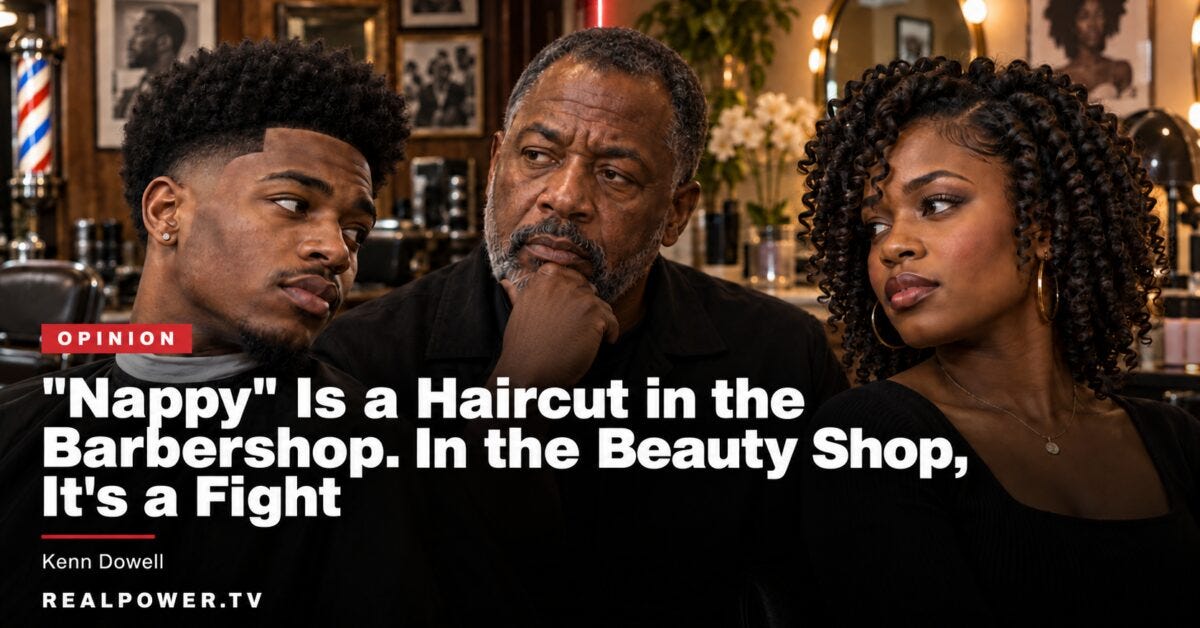
A few weeks ago I looked across the room at my daughter and asked if she planned to keep wearing that nappy fro.
She let me have it. It wasn’t a fro, she told me. It was a twist-out. And the word I used to describe it was an insult.
I apologized on the spot, and I meant it. If you hurt somebody, whoever they are, you own it. She and I are fine. But that word stayed with me for days, and I want to tell you why, because it isn’t the reason you might think.
Let me start with where I stand.
When my wife and I first got together, she wore a perm. I wasn’t sitting on the couch while she handled it. I was right there helping her put it in. So when she told me she was done with perms and going natural, the change wasn’t only hers. I had to learn her hair all over again, same as she did.
I’m glad she made the move. My wife doesn’t need a lot of makeup to be beautiful to me, and she doesn’t wear much. She’s a naturally beautiful woman, and I see the same thing in all my daughters. When a woman in my house walks away from the chemicals, I’m not the man standing in the way. I’m the one who already said yes. And don’t get me started on the weave. That’s a whole other conversation.
I’ve carried that outside my house too. I’ve worked alongside Congresswoman Shontel Brown, who put her name on the CROWN Act, the federal bill to ban hair discrimination. I’ve stood with women who believe a Black woman’s natural hair should never cost her a job, a promotion, or a seat in a classroom.
So when my daughter heard an insult, I needed to know whether I’d been carrying one around without knowing it.
I went looking.
On Our Side of the Shop, the Word Stayed Plain
Where I come from, “nappy fro” is a haircut. Not a put-down. A description. It still is. Barbers post it by name. Young men ask for a nappy fro with a taper, and nobody in the chair flinches. On our side of the shop, the word stayed plain.
On the other side of the shop, it never got the chance.
For Black women, that word has been a fight for as long as I’ve been alive. In 1997, a children’s book called Nappy Hair set off a national argument. Two years later, bell hooks answered with Happy to Be Nappy, written to hand the word back to little Black girls as something to smile about. Some women took it back and wore it proud. Plenty of others never could, because it was the word said over their heads before the hot comb came out.
Then in April 2007, Don Imus got on the radio and used that word, tied to a slur, against the Rutgers women’s basketball team, mostly Black young women who had just played for a national championship. CBS Radio fired him within days.
My daughter’s generation came up after that. The word they inherited wasn’t a haircut. It was a headline.
So here’s what actually happened in my living room. I spoke barbershop. She heard the beauty shop. We were fluent in two versions of the same word, and nobody had ever sat those two versions down at the same table.
She was still right on the specifics. What I call a nappy fro is texture picked out and shaped. What she wore took hours: twisted, set overnight, unraveled for definition. My word was aimed at the wrong style, in the wrong room.
Whoever Names a Thing Decides What It’s Worth
Now let me tell you why this belongs in a power paper.
Nobody in our community picked the word “nappy.” It was put on Black hair from the outside, by people who decided it was a problem. The words my daughter uses were picked from the inside. Twist-out. Coily. 4C. A whole language built by Black women who decided to do their own naming.
Whoever names a thing decides what it’s worth. I’ve watched that play out in Cleveland for two decades, over land, over contracts, over votes. The people with power call a neighborhood blighted, and then the neighborhood gets priced like it. The same thing was done to our hair long before anybody wrote a law about it. That’s why the CROWN Act had to exist at all.
Black men and Black women have looked at the same hair in the same houses for generations, talking about it in two languages and rarely comparing notes. That gap cost me a hard moment with my daughter.
I’m 58 years old, and my child still corrected me. Good. That’s how it’s supposed to work.
So I’ll put the question to both sides of the shop. Men: What did they call it in your barbershop? Women: What did that word do to you?
As for me, I believe in natural beauty. I said I wouldn’t get started on the weave, so I’ll only say this. Going without the chemicals is good, and so is going without the glue. The American Academy of Dermatology tells women who wear weaves to choose sewn-in over bonding glue, because the pulling can cost you your own hair.
I’m not going deep in those weeds. I don’t need every woman in Cleveland coming at me. But natural is a beautiful thing, on our heads and in how we live, and I felt it needed to be said.
Cleveland went years without a Black paper. We picked it back up. RealPower.TV is independent, Black-owned, and free to read, and subscribing is what keeps it that way. You get the story before somebody else gets around to explaining it to you.
Subscribe and stand with the work. → realpower.tv/join