


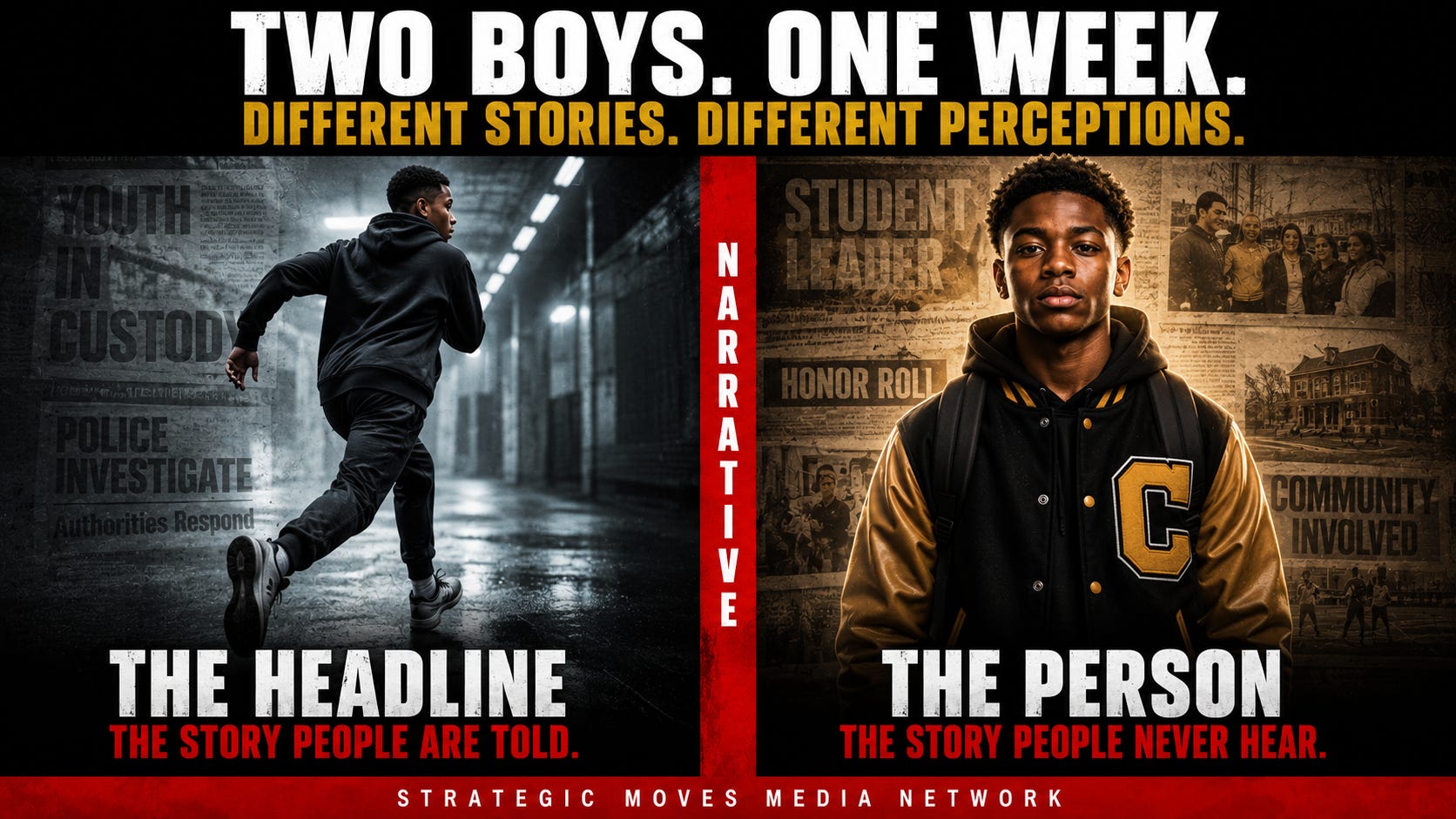
Let me tell you what happened this week — and why it didn’t surprise me.
Two cases. One week. Same America.
Let’s start with Cyrus Carmack-Belton. Fourteen years old. Columbia, South Carolina. He was accused of shoplifting from a gas station — accused, not proven. The video showed he put the water bottles back. He didn’t steal anything. But Rick Chow and his son chased that child over 130 yards away from the store. One hundred and thirty yards. That boy was running for his life. And when they caught up to him — Chow shot him in the back.
Now here’s what I need you to sit with. The jury deliberated for over eight hours before coming back unanimous — not guilty. The family said it plain: a jury watched their 14-year-old boy run away from two grown men on video. They knew one of them shot him in the back. And they still said no one is to blame.
His family also acknowledged that Cyrus had a gun on him. But here’s what nobody wants to say out loud — that child was being chased by two grown men. He didn’t pull that weapon. He ran. He ran 130 yards trying to get away. The fact that he felt he needed to carry a gun for protection in the first place tells you everything about the world these boys are navigating every single day. He wasn’t the aggressor. He was a child trying to survive.
His father Troy said it best: to him, this felt like another setback for young Black males everywhere. Said it’s like you just can’t get justice nowhere.
Now let’s talk about Karmelo Anthony.
Seventeen years old. A high school student in Frisco, Texas — one of the fastest growing cities in the state, dotted with gleaming school campuses and athletic facilities. Both Karmelo and the young man he was involved with were described as good students who planned to go to college. This wasn’t a story about two troubled kids. This was two boys at a track meet.
What witnesses described was a heated exchange that started when Karmelo refused to leave a tent that belonged to the other team on a rainy day. Words turned into a confrontation. Metcalf pushed Karmelo. Karmelo pulled a knife and stabbed him.
Now — most people carry a pocketknife. That ain’t the story. The story is that Karmelo said he was afraid. Said he was being confronted, being pushed, felt his life was in danger. He claimed self-defense. The jury rejected it. They convicted him of murder — not manslaughter, murder — and sentenced him to 35 years in prison. Thirty-five years. For a boy who was seventeen years old at the time and said he was scared.
Both of these young men felt they were in fear of their lives. One ran and was shot in the back anyway. The other stood his ground and is now going to prison until he’s in his fifties. In both cases they were provoked. In both cases they responded out of fear. And in both cases this country decided their fear didn’t count.
Now compare that to Kyle Rittenhouse.
He crossed state lines. He carried a rifle. He killed two people. And from the jump — before any trial, before any verdict — the media gave him something our boys will never get. They gave him a story.
They called him scared. Called him a kid just trying to protect his community. They debated his intentions with care and nuance. They put up the photos that made him look human.
You know what they do when it’s one of ours?
They pull the worst picture they can find. They run the record. They let people speculate before the facts are even in. And by the time that jury sits down — the verdict has already been shaped. Not in the courtroom. In the headlines.
I know this because I’m in media. I built Strategic Moves Media Network because I watched this happen too many times and understood — the problem ain’t just in the courtroom. It’s in who controls the camera.
Trayvon Martin was walking home minding his business. His killer walked. But before that verdict, the media spent weeks asking whether Trayvon’s hoodie made him look suspicious. Think about that. A child. And they put his clothes on trial.
George Stinney Jr. was fourteen years old. Barely five feet. Under a hundred pounds. His trial lasted two hours. They strapped him into an electric chair his body was too small to fit. Executed for a crime he did not commit. And his conviction wasn’t overturned until 2014 — seventy years later. There was no camera fighting for his narrative. No platform. No infrastructure. Just a Black child and a system that had already decided.
From 1944 to 2026. The chair became a courtroom. The rope became a headline. But the outcome stays the same when we don’t control the story.
Now let me speak to you as a father.
I got four kids — three daughters and a son. I check on all of them. Every morning, before this work starts, before anything else, I’m checking locations. That’s just what a father does.
But today I’m talking specifically about my son. Because what it means to raise a Black boy in this country carries a weight that I have to speak to directly.
Every morning I check on him and I exhale when I see he’s good. I thank God. And then I ask Him to cover him one more day — because I know what he’s walking into every time he steps out that door.
That ain’t overprotective. That’s what it costs.
You love them with everything you got. You teach them to be excellent — not because excellence guarantees protection, but because you refuse to give this world any excuse. You send them out the door and carry something in your chest that never fully goes away.
Because you already know — it don’t matter how well they carry themselves. Don’t matter how educated they are, how gentle, how well-spoken, how sharp. Their Blackness is going to show up before they do. And if there’s no counter-narrative strong enough to push back — this country’s default story about Black boys will keep shaping verdicts.
That’s why Black media isn’t a nice-to-have. It’s survival infrastructure.
Not reaction. Not commentary. Infrastructure — the kind that gets built before the crisis hits. The kind that puts our humanity in the frame before a prosecutor ever stands up to paint a picture.
Rittenhouse had a whole ecosystem of media telling his story the way he needed it told. Our boys deserve the same — not sympathy, but a fair frame. A platform that refuses to reduce them to a mugshot and a statistic.
That’s what we’re building here at Strategic Moves. Every episode. Every post. Every platform we own and refuse to let go of.
Two verdicts. One week. A pattern that goes back eighty years.
I check my son every morning. I run this network every day.
Both of those things are necessary. Both of them are resistance.
Drop a comment — what are YOU doing, beyond the post and the share, to change who controls the narrative?
Watch and listen at Strategic Moves Media Network → [https://www.youtube.com/@StrategicMovenetwork]
Hi keep up the good work you’re articulating the message very well.Thank You!.